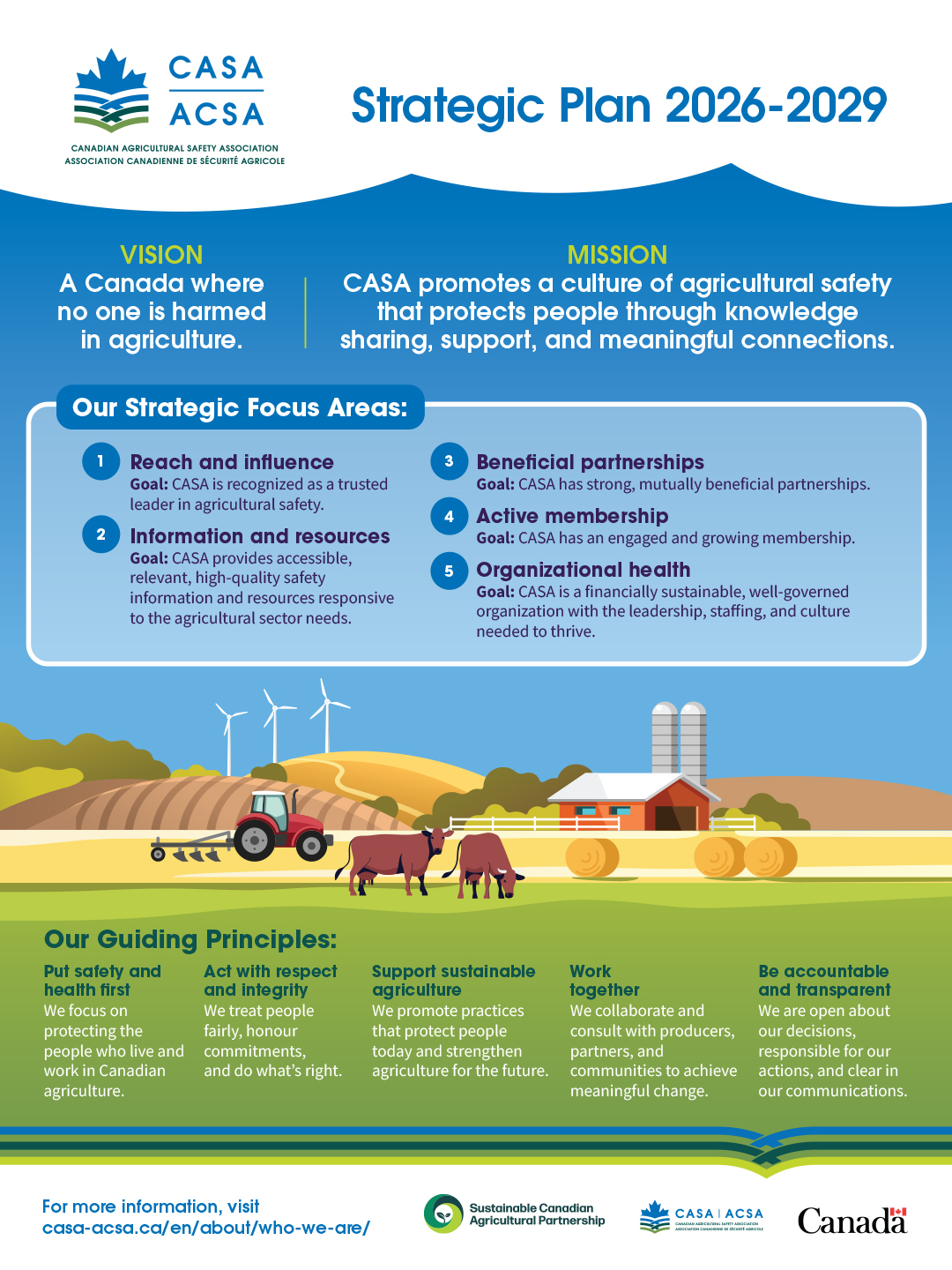
Vision
A Canada where no one is harmed in agriculture.
Mission
CASA promotes a culture of agricultural safety that protects people through knowledge sharing, support, and meaningful connections.
About CASA
On average, more than 60 adults and children lose their lives in agricultural incidents each year in Canada, making agriculture one of the country’s most hazardous industries.
Founded in 1993, the Canadian Agricultural Safety Association (CASA) is a national non-profit organization dedicated to improving farm safety across Canada. CASA supports initiatives that provide producers, farm families and workers with the tools and resources needed to make farms, ranches and farming communities safe places to live and work.
CASA is governed by a seven-member Board of Directors representing members from across the agricultural sector
Guiding Principles
-
Put safety and health firstWe focus on protecting the people who live and work in Canadian agriculture.
-
Act with respect and integrityWe treat people fairly, honour commitments, and do what’s right.
-
Support sustainable agricultureWe promote practices that protect people today and strengthen agriculture for the future.
-
Work togetherWe collaborate and consult with producers, partners, and communities to achieve meaningful change.
-
Be accountable and transparentWe are open about our decisions, responsible for our actions, and clear in our communications.
Commitment to Inclusion, Equity, Diversity and Accessibility
The Canadian Agricultural Safety Association (CASA) operates on the traditional territory of First Nation, Inuit and Métis peoples from coast to coast to coast and acknowledges the inherent Indigenous Rights and Treaty Rights of all Indigenous Peoples across these lands.
CASA believes that health and safety includes fostering an inclusive environment, where everyone is welcomed. CASA’s vision for a safe and sustainable agriculture where healthy Canadian farm communities thrive includes diversity, equity, and inclusion to promote the representation and participation of persons of different ages, races and ethnicities, abilities and disabilities, genders, cultures, sexual orientations, and religion. We support a learning culture that raises awareness and takes action to support the industry against prejudice and discrimination in all its forms.
CASA believes that having leaders who reflect diversity in life experiences and cultural backgrounds contributes to more balanced Board deliberations and better decision-making. Creating an inclusive culture that embraces differences also best positions CASA to address evolving member needs.
Download our latest Annual Report
Download our latest Brochure

CASA 2026-2029 Strategic Plan
As a national non-profit organization, the Canadian Agricultural Safety Association (CASA) takes a collaborative approach working with partners to support initiatives that equip producers, their families, and workers with the information and tools needed to recognize risks and manage hazards to keep farms safe.