

CASA Co-Hosting International Symposium on Advancing Health and Safety in Rural and Agricultural Populations
Winnipeg, MB, May 19, 2026 – The Canadian Agricultural Safety Association (CASA) will co-host the upcoming Safety and Health in Agricultural and Rural Populations (SHARP) international symposium, taking place June 16-18, 2026, in Saskatoon. Hosted by the University of Saskatchewan’s Canadian Centre for Rural and Agricultural Health (CCRAH) in collaboration with the International Society for […]
Canadian Agricultural Safety Association Celebrates Nurturing the Future of Agriculture with Kids FarmSafe Week
Winnipeg, MB, May 11, 2026 – The Canadian Agricultural Safety Association (CASA) is proud to host the annual Kids FarmSafe Week, taking place May 11-17, highlighting the vital role of farm safety in “Nurturing the Future of Agriculture.” Now in its third year, Kids FarmSafe Week encourages farm families, farm workers, and farming communities to #KeepKidsFarmSafe with activities and resources that raise awareness about farm health and safety risks for children and youth. According to recent Canadian Agricultural Injury Reporting data, 435 children and youth […]
Canadian Agricultural Safety Association Launches New Strategic Plan
Winnipeg, MB, May 6, 2026 – The Canadian Agricultural Safety Association (CASA) is proud to announce the release its 2026-2029 Strategic Plan, a forward-looking framework that builds on the organization’s established foundation to promote health and safety in agriculture. The new three-year plan reflects CASA’s belief that safe and sustainable agriculture must embrace diversity, equity, […]
Canadian Agricultural Safety Association Launches New Emergency Preparedness Hub
Winnipeg, MB, March 18, 2026 – The Canadian Agricultural Safety Association (CASA) is pleased to announce the launch of its new Emergency Preparedness Hub, bringing together practical information and resources in one place to help farmers, farm families, farm workers, and farming communities. The Emergency Preparedness Hub contains tools developed by CASA, materials from other organizations, and […]
Canadian Agricultural Safety Association Unveils New Vision and Mission Statements
Winnipeg, MB, March 16, 2026 – As part of Canadian Agricultural Safety Week, the Canadian Agricultural Safety Association (CASA) is pleased to announce its new vision and mission statements, underscoring the organization’s ongoing commitment to promoting agricultural safety. CASA’s new vision: A Canada where no one is harmed in agriculture. CASA’s new mission: CASA promotes a culture of agricultural […]
Cultivating Wellness: Honouring the International Year of the Woman Farmer
Winnipeg, MB, February 25, 2026 – In recognition of International Women’s Day, the Canadian Agricultural Safety Association (CASA) is celebrating the International Year of the Woman Farmer and all of the contributions women make to the Canadian agricultural industry. The Food and Agriculture Organization of the United Nations (FAO) has declared 2026 the International Year of the Woman […]
CASA Celebrates Annual Agricultural Safety Week
Farmers and ranchers encouraged to make #FarmSafetyEveryday a year-round priority Winnipeg, MB, February 18, 2026 – This year’s Canadian Agricultural Safety Week takes place March 15-21, encouraging farmers, farm families, farm workers, and farming communities to make #FarmSafetyEveryday a top priority. Canadian Agricultural Safety Week (CASW) is an annual national initiative delivered by the Canadian […]
The Canadian Agricultural Safety Association Announces New Board Members for 2025-2026
Winnipeg, MB — October 15, 2025: The Canadian Agricultural Safety Association (CASA) welcomes two new board members for 2025-2026. Neil Armer, Health & Safety Manager with AgriHub Family of Companies, and Dr. Chadwick Koscielny, North America Canola Breeding Lead at Corteva Agriscience were elected by CASA’s membership to join the seven-person Board of Directors. With more […]
Bunge Continues Legacy of Supporting Farm Safety with BeGrainSafe Sponsorship
Winnipeg, MB, September 16, 2025 –The Canadian Agricultural Safety Association (CASA) is proud to recognize Bunge, a premier global agribusiness company, for its ongoing support of CASA’s BeGrainSafe program. Viterra, a long-standing sponsor of BeGrainSafe, is now part of Bunge, after its business combination was completed in July. CASA is deeply grateful that Bunge has […]
The Canadian Agricultural Safety Association Secures $1.6 Million Investment to Enhance Agricultural Safety Through the AgriCompetitiveness Program
Winnipeg, MB, March 13, 2025 – The Canadian Agricultural Safety Association (CASA) will receive up to $1.6 million over 3 years from Agriculture and Agri-Food Canada (AAFC), through the AgriCompetitiveness Program under the Sustainable Canadian Agricultural Partnership, to advance agricultural health and safety across Canada. “This continued support and commitment of Agriculture and Agri-Food Canada […]
Justin Birch
After a baler injury, Justin Birch can now move and stack hay bales easily with the addition of a coverall building. September 20, 2020, was just a regular day on the farm for Justin Birch – until everything changed. Birch, who runs a third-generation beef farm near the east end boundary of Ottawa, was doing […]
Glen Duck

From Moose Jaw to Prince Albert, from Yorkton to Meadow Lake, Duck and other SAASE members have hosted Safety Days all across the province. All successful Safety Days depend on the dedication of volunteer coordinators. These individuals volunteer their time, energy and efforts in making sure that children and communities receive the best possible safety […]
Shari Hinz

Safe Communities Humboldt & Area Safety Days operate as part of an elementary school day, with support from the teachers, principal, professional presenters and volunteers. Shari Hinz knows that keeping kids safe on the farm involves education. That’s why the Executive Director of Safe Communities Humboldt & Area in Saskatchewan says staff and volunteers have […]
André Veilleux
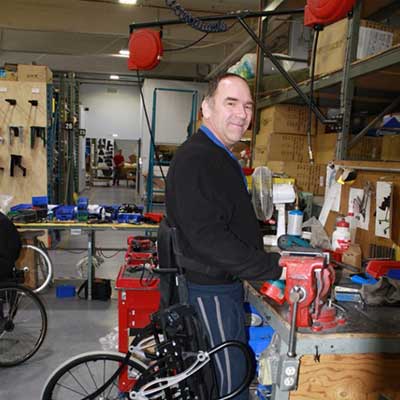
Depuis son obtention d’un fauteuil verticalisateur à la suite d’une blessure lors de l’abattage d’un arbre, la capacité de travailler, la qualité de la vie et la santé d’André Veilleux ont amélioré. André Veilleux, un producteur de sirop d’érable du Québec, a reçu des fonds pour appuyer l’achat d’un fauteuil roulant élévateur qui a considérablement […]
Mark Verleun

Since receiving a new cattle handling system, Mark Verleun has been able to move his cattle safely in spite of a severe leg and knee injury. In March 2015, PEI farmer Mark Verleun was involved in a head-on collision. As a result, Mark experienced severe trauma to his leg and knee, impacting his ability to […]
Barry Cloutier

Since receiving a cattle-feed cart, Barry Cloutier finds it easier to keep up with over 200 head of livestock following a baler injury. Barry Cloutier is farming easier, safer and with less pain these days thanks to a grant from Back to Ag, a program that helps producers and agricultural workers purchase assistive technology following […]
Yvan Bergeron

Yvan Bergeron is able to navigate his dairy operation safely and productively thanks to several adaptations and a small utility vehicle following a PTO injury. Yvan Bergeron knows how hard it is to keep a farm going following a farm injury. In 2011, the dairy farmer from St-Samuel, Quebec was performing maintenance on a hay […]
Latest Canadian Agriculture-Related Fatality Data Available
Winnipeg, MB, Feb 16, 2017: According to the latest Canadian Agricultural Injury Reporting (CAIR) information, agriculture-related fatalities are declining. CAIR is the only source of national agriculture-related fatality data in Canada. From 1990 to 2001, an average of 116 people died due to an agriculture-related incident. From 2002 to 2012, the average number of agriculture-related […]
Agricultural Runovers in Canada: Overview
Updated July 2008 Agricultural equipment runovers are second only to machine rollovers as a cause of death on Canadian farms and ranches. They are the fourth most frequent reason people are hospitalized for machine-related agricultural injuries. Between 1990 and 2004, 313 people were killed in agricultural runovers. From April 1990 to March 2000 there were […]
Agricultural Machine Rollovers in Canada: Sideways Rollovers
Updated July 2008 Most sideways rollovers occur near farm and rural roadways when a tractor or other agricultural machine is inadvertently driven too close to the edge of a ditch. Other typical causes of sideways rollovers include operating a machine on a steep incline and cornering at excessive speed. In the fifteen years from 1990-2004, […]
Agricultural Machine Rollovers in Canada: Backwards Rollovers
Updated July 2008 Backwards rollovers most frequently occur when a tractor or agricultural machine is used to tow a vehicle, implement, or other heavy load. In several of the backwards rollover fatalities documented by CAIR, an operator attached a tow chain beneath a tractor’s seat rather than at the level of its draw pin. Because […]
Agricultural Runovers in Canada: Overview
Updated July 2008 Agricultural equipment runovers are second only to machine rollovers as a cause of death on Canadian farms and ranches. They are the fourth most frequent reason people are hospitalized for machine-related agricultural injuries. Between 1990 and 2004, 313 people were killed in agricultural runovers. From April 1990 to March 2000 there were […]
Agricultural Runovers in Canada: Extra Riders
Updated July 2008 Extra rider runovers occur when a passenger falls or is bounced or knocked from a moving farm machine, usually a tractor. The passenger is then runover by the machine or by an implement or wagon being pulled by it. In almost all cases, the machine on which the victim was riding was […]
Agricultural Runovers in Canada: Bystander Runovers
Updated July 2008 In bystander runovers the victim, often a child, is run over by a vehicle or agricultural machine because the driver is unaware of his/her presence or cannot avoid the collision. Between 1990 and 2004, 87 people were killed in bystander runovers. From April 1990 to March 2000 an additional 325 people were […]
Agricultural Runovers in Canada: Unmanned Machine Runovers
Updated July 2008 Unmanned machine runovers can be further classified into alighted operator runovers and improper start runovers. Alighted operator runovers occur when an unmanned tractor or other agricultural machine slips into gear or rolls down an incline running over a person (usually the operator) standing in its path. Improper start runovers take place when […]
Agricultural Runovers in Canada: Fallen Operator Runovers
Updated July 2008 Fallen operator runovers occur when an operator falls or is bounced or knocked from a moving farm machine, usually a tractor. The operator is then runover by the machine or by an implement or wagon being pulled by it. Between 1990 and 2004, 59 people were killed in fallen operator runovers. From […]
Agricultural Injuries in Canadian Children: Overview
Updated July 2008 Between 1990 and 2004, 209 children under fifteen years old were killed in agricultural injury events. From April 1990 to March 2000 an additional 1,886 children were hospitalized for treatment of agricultural injuries. Agricultural injuries in children comprised 12.5% of all agricultural fatalities and 12.7% of all hospitalizations for agricultural injuries. 74.2% […]
Agricultural Injuries in Canadian Children Under 5 Years Old
Updated July 2008 Preschool children under five years of age are extremely vulnerable to fatal agricultural injuries. The most frequent causes of fatalities among very young children were bystander runovers, drownings and extra rider events. 40.4% of runover events in preschool children resulted in the death of the child. Animal-related incidents, machine entanglements, falls from […]
Agricultural Injuries in Canadian Children Aged 5 to 9
Updated July 2008 Bystander runovers, extra rider runovers and drownings were the most important causes of death in young school-aged children aged five to nine years. The most frequent reasons for hospitalized injuries in this age group were falls from height, animal-related incidents, entanglements and being runover as extra riders or bystanders. Young school-aged children […]
Agricultural Injuries in Canadian Children Aged 10 to 14
Updated July 2008 The most frequent causes of death for school-aged children ten to fourteen years old were tractor and off road vehicle (ORV) rollovers, extra rider runovers, and ORV collisions. Older school-aged children were most commonly hospitalized for animal-related incidents, falls from height, entanglements and being pinned or struck by a machine. Children aged […]
Agricultural Injuries in Canada: Adults Aged 60 and Over
Updated July 2008 Senior farmers aged 60 and over represent only 14.4% of the Canadian farming population (2001), but they suffered 35.9% of all agricultural fatalities and 23.4% of agricultural hospitalizations. In the fifteen years from 1990-2004, 601 older farmers were killed in agricultural injury events. Between April 1990 and March 2000, 3,469 farmers aged […]
Gender Differences in Agricultural Injuries
Updated July 2008 In the fifteen years from 1990-2004, 1,530 males and 145 females were fatally injured on Canadian farms and ranches. Between April 1990 and March 2000, 12,305 males and 2,525 females were admitted to hospital because of agricultural injuries. Males are far more likely than females to be killed or hospitalized as a […]
Drownings on Canadian Farms and Ranches
Updated July 2008 Between 1990 and 2004, 62 people were killed in drowning events on farms and ranches. Ten of these victims drowned in vehicles or machines as a result of a collision with a water hazard. From April 1990 to March 2000 an additional eight people were hospitalized for near drownings. 87.5% were children […]